Simple inflatable robots bend through uncontrolled membrane buckling — no defined axes, no repeatable motion, no stiffness control. This project solves that by embedding a modular origami spine inside an inflatable humanoid-scale torso, pairing pneumatic deployment with tendon-driven joint control.
Conceived, designed, fabricated, and validated independently under faculty supervision.
Accepted to ICRA 2026 - View PDF
1. Origami Spine Architecture
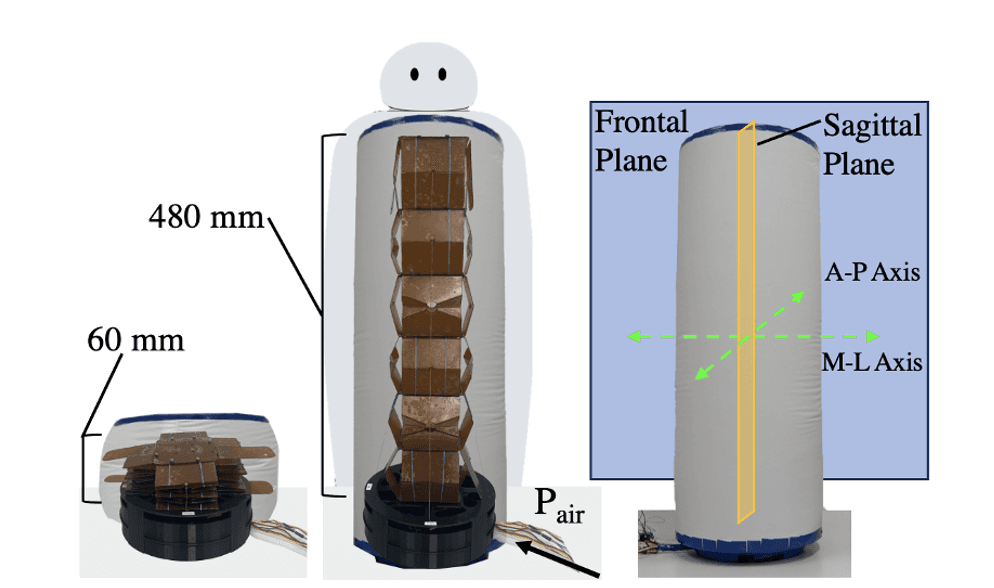
Three module types stack to form the spine: a self-locking module for single-axis control, a 2-DoF waterbomb module for lateral bending and axial rotation, and a 3-DoF spherical module for neck-level flexibility. Kapton-glass fiber laminate hinges — bidirectional and unidirectional — are mixed deliberately to enable human-like mobility while passively preventing undesired back-bending.
2. Hybrid Pneumatic–Tendon Actuation
Pneumatics deploy the collapsed spine and provide global stiffening. Six servo motors drive independent tendon groups for sagittal bending, frontal bending, and self-locking engagement. The key design decision: separate deployment from joint control so neither function compromises the other.
3. Experimental Evaluation
Four dimensions tested: range of motion vs. anatomical standards, open-loop repeatability across reinflation cycles, lateral stiffness under pneumatic-only vs. combined actuation, and stiffness-mobility trade-offs from 70 to 120 kPa. Each condition ran 10-15 trials with full deflation and reinflation between trials.
Range of Motion
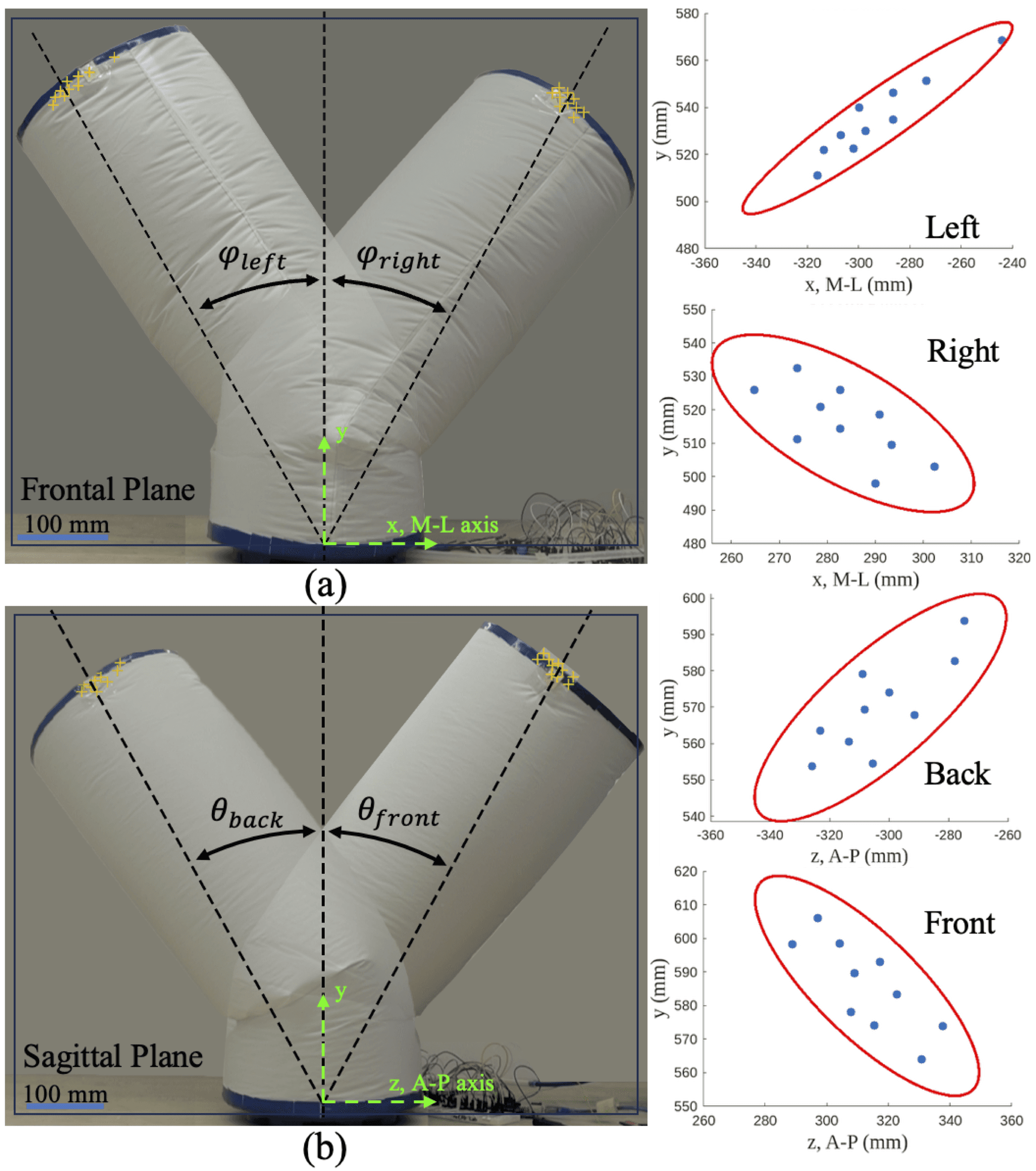
Sagittal range exceeded anatomical norms — 27.6° back and 27.4° front vs. human standards of 26° and 22°. Frontal range reached 28.75° left and 28.5° right, slightly below the 30° anatomical standard.
Tunable Stiffness
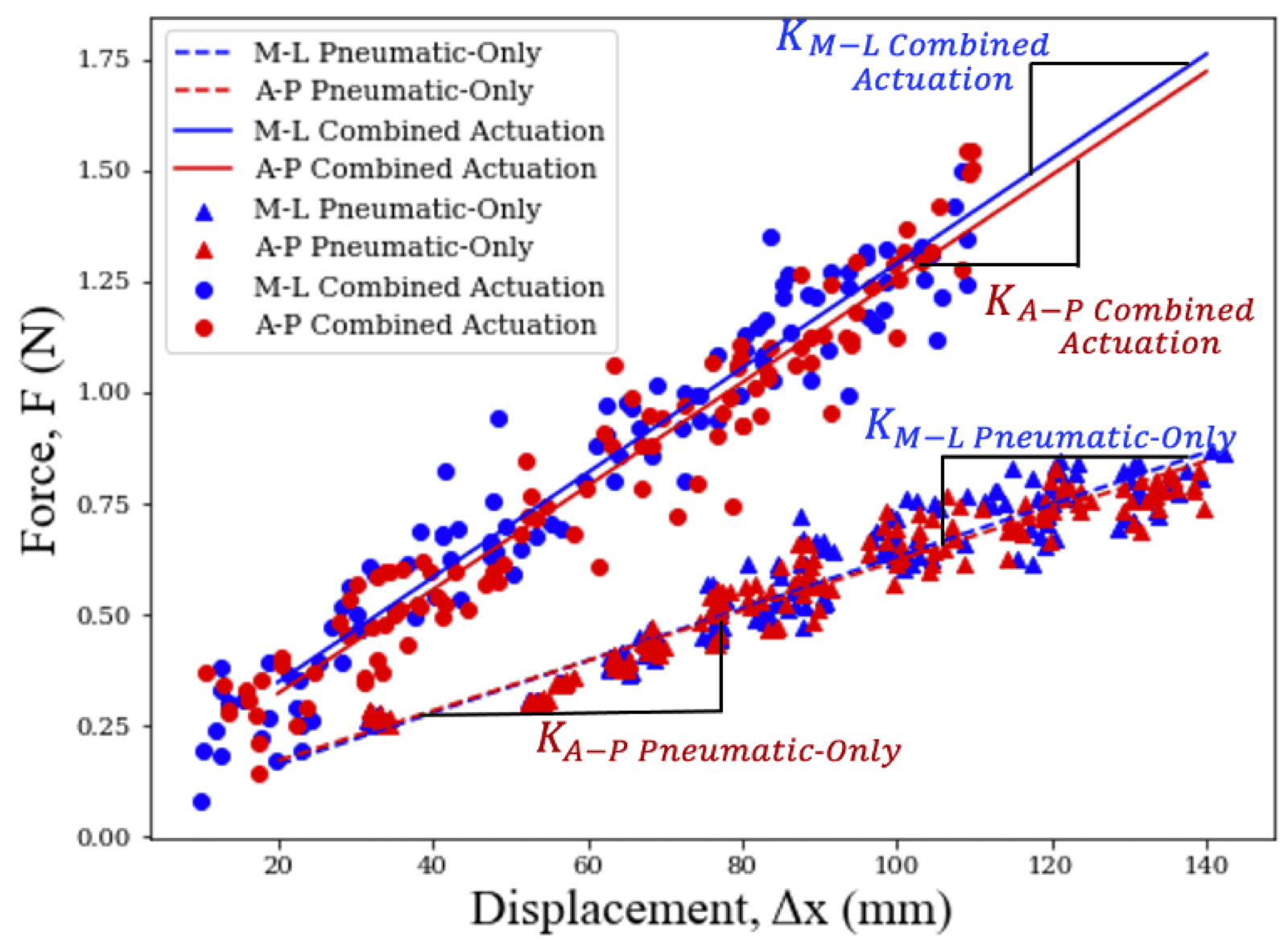
Tendon engagement doubled lateral stiffness relative to pneumatic-only inflation — 0.012 N/mm vs. 0.006 N/mm. Stiffness increases linearly with pressure while range of motion decreases, giving a continuous and designable trade-off between compliance and structural support.
Deployability
Collapses from 480 mm to 60 mm deployed height — 12.5% stowage ratio. Uncommon at humanoid torso scale.
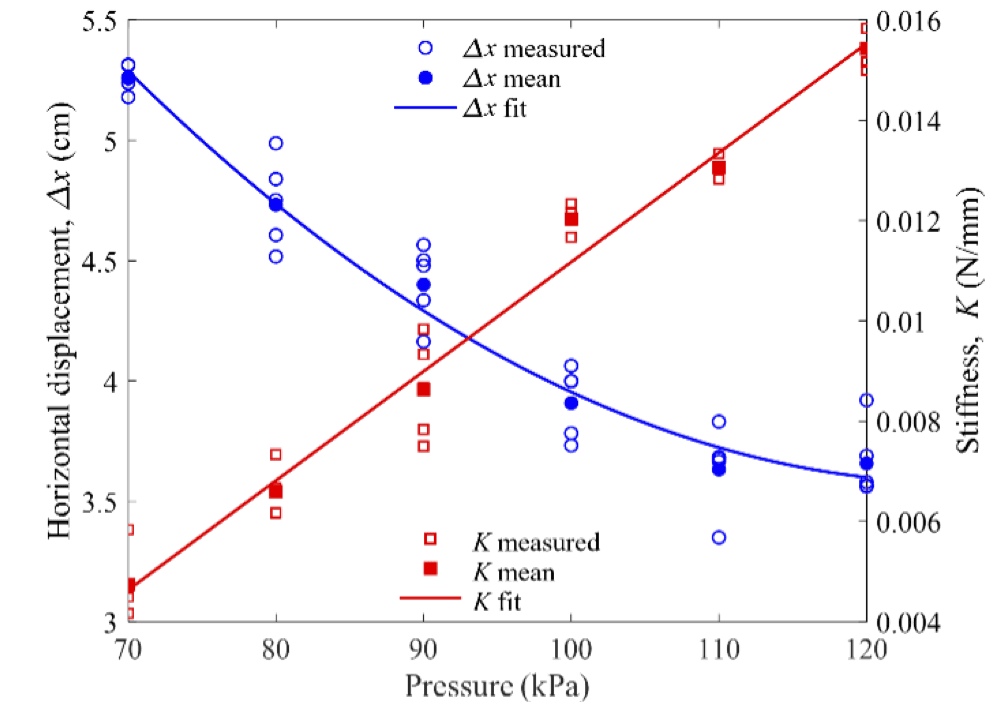
Stiffness, pressure, and range of motion form a three-way trade-off that cannot be resolved by tuning one parameter alone — it has to be designed around from the start.
The clearest limitation: the torso cannot sense its own stiffness state during motion. That gap directly motivated the embedded sensing work at CMU's Biorobotics Lab.
Conceived and led the full project independently from concept through ICRA 2026 submission.
Designed the complete origami spine: joint geometry, self-locking mechanism, hinge material selection, and tendon routing.
CAD-modeled and fabricated all components including hinge modules and spine-shell interface.
Developed the hybrid actuation system and six-servo control base.
Designed and conducted all experiments, built data analysis pipelines, and generated all figures.