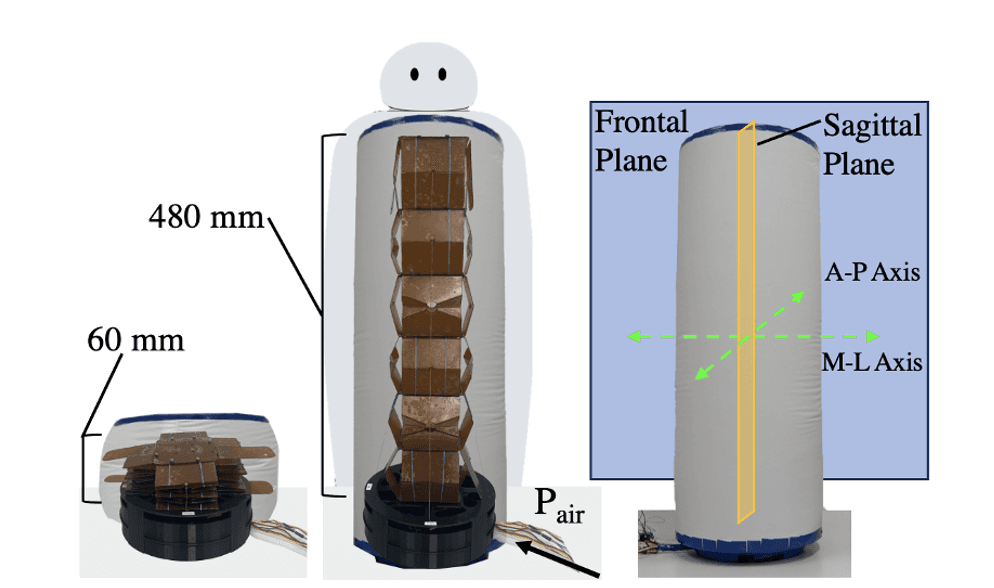
This project develops a distributed impact-telemetry system to measure high-energy head–neck dynamics using synchronized inertial sensors. Traditional single-point sensors cannot capture multi-segment motion, limiting their value for injury analysis. I am building a dual-IMU, ground-truth-validated platform to estimate intermediate neck behavior during impact events.
Technical details available upon request due to confidentiality obligations.
1. Distributed Sensing Architecture
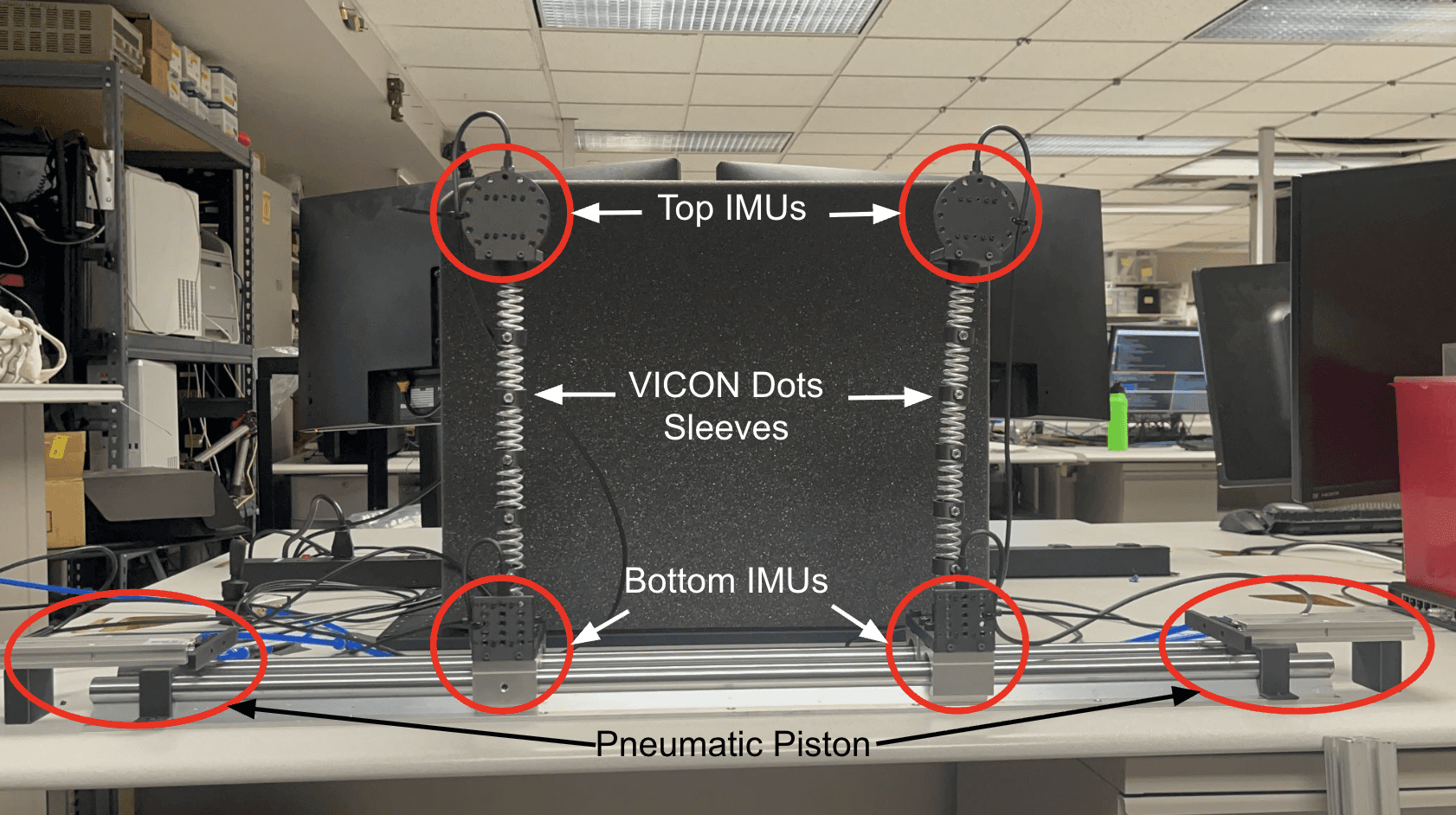
Two high-G IMUs are mounted on the head and shoulders using rigid, non-slip fixtures. A custom PCB integrates ESP32, Teensy, dual I²C buses, power management, and wireless logging to enable synchronized, high-rate data capture during impacts.
2. Pneumatic Impact Testbed
A pneumatic piston accelerates torso–neck–head assemblies on linear rails to create repeatable collisions. Adjustable air pressure allows controlled variation of impact severity for experimental comparison.
3. Ground-Truth Motion Capture
A Vicon system records 6-DoF head, neck, and shoulder trajectories. TTL pulses from the Vicon Lock Lab unit synchronize its timeline with the IMU logger, enabling direct alignment between inertial data and motion-capture ground truth.
4. Kinematic and Injury-Metric Estimation
Analysis pipelines extract pre-impact velocity, neck bending profiles, angular displacement, and curvature from the dual-IMU data. Variability is assessed across repeated trials and pressure levels to evaluate consistency. These metrics form the basis for comparing IMU-based estimates with biomechanical injury thresholds.
Segment-Level Impact Capture
Dual-IMU data consistently separates head and shoulder dynamics during impact, revealing clear differences in acceleration and angular response.
Pre-Impact Velocity Consistency
Trials at fixed pressure show stable pre-impact velocity profiles, supporting controlled comparison of impact severity and loading conditions.
Neck Motion Estimation Trends
Early IMU-based estimates of neck bending and directional change follow the same trends observed in Vicon ground truth, indicating feasibility for intermediate joint inference.
Preliminary experiments show that single-point telemetry misses key multi-segment dynamics, while distributed sensing reveals richer motion structure during high-energy collisions. IMU-to-Vicon comparisons indicate that neck-state trends can be inferred without placing sensors directly on the neck, highlighting where estimation is reliable and where further modeling is needed. These findings motivate a deeper investigation into joint-state reconstruction and injury-related metrics.
Integrating neck-spring modeling for improved joint-state estimation
Adding filtering (EKF/complementary) for real-time inference
Expanding experiments across more anatomical configurations
Validating estimated metrics against injury-threshold literature