Dynamic Planar Manipulation via Inertial Reorientation
@ CMU — Mechanics of Manipulation
Introduction
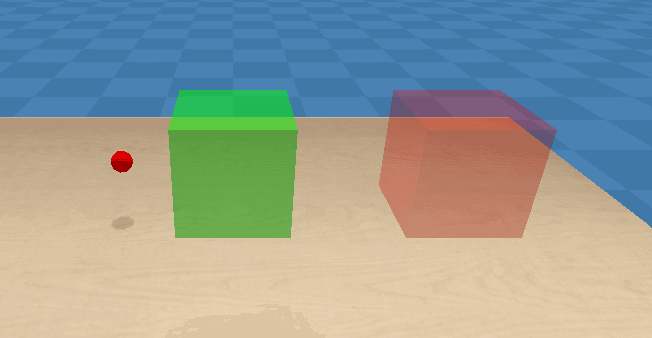
When a robot taps an object off-center, the resulting translation and rotation are governed by impact physics — not continuous control. If that post-impact motion can be predicted and steered, a single well-placed push becomes a manipulation primitive. This project investigates whether a single impulsive contact can reliably reposition a planar rigid body toward a target pose using only its natural free motion after impact.
A closed-form analytic model derived from impulse-momentum relations is compared directly against physics simulation — running in the same environment, with the same geometry — to isolate exactly where idealized theory breaks down against real contact physics.
Methods
1. Analytic Impact Model
A rigid-body impulse-momentum model predicts post-impact translational and angular velocity from contact location and applied impulse. The model assumes an instantaneous, frictionless impact followed by free motion — no ground friction, no finite contact duration.
2. Physics Simulation
The same geometry and impulse conditions are implemented in a physics engine. Because both analytic and simulated systems run in the same environment, any trajectory divergence originates exclusively from contact physics differences: finite-duration impact, ground friction, and sliding-to-sticking transitions.
3. Inverse Problem — Optimizing a Single Push
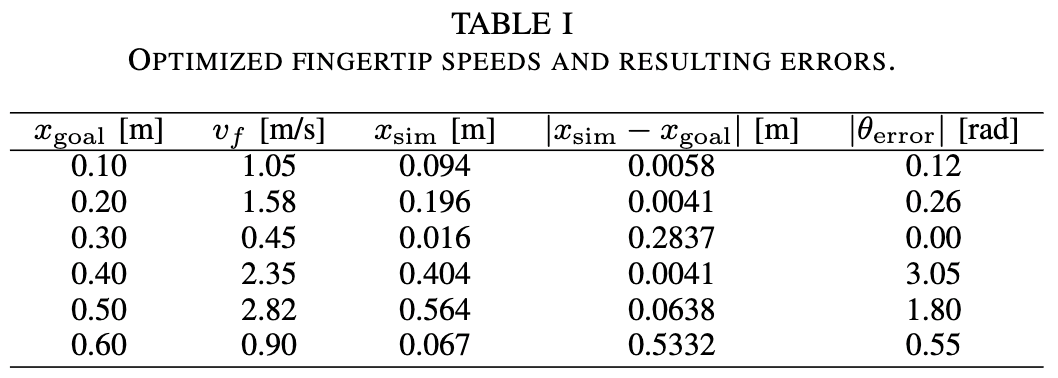
Given a desired target position, fingertip speed is optimized to minimize final position error. This tests whether analytically reachable poses are physically achievable under realistic contact dynamics.
Analytical Solution
Physics Simulation
Results
Analytic vs. Simulated Trajectories
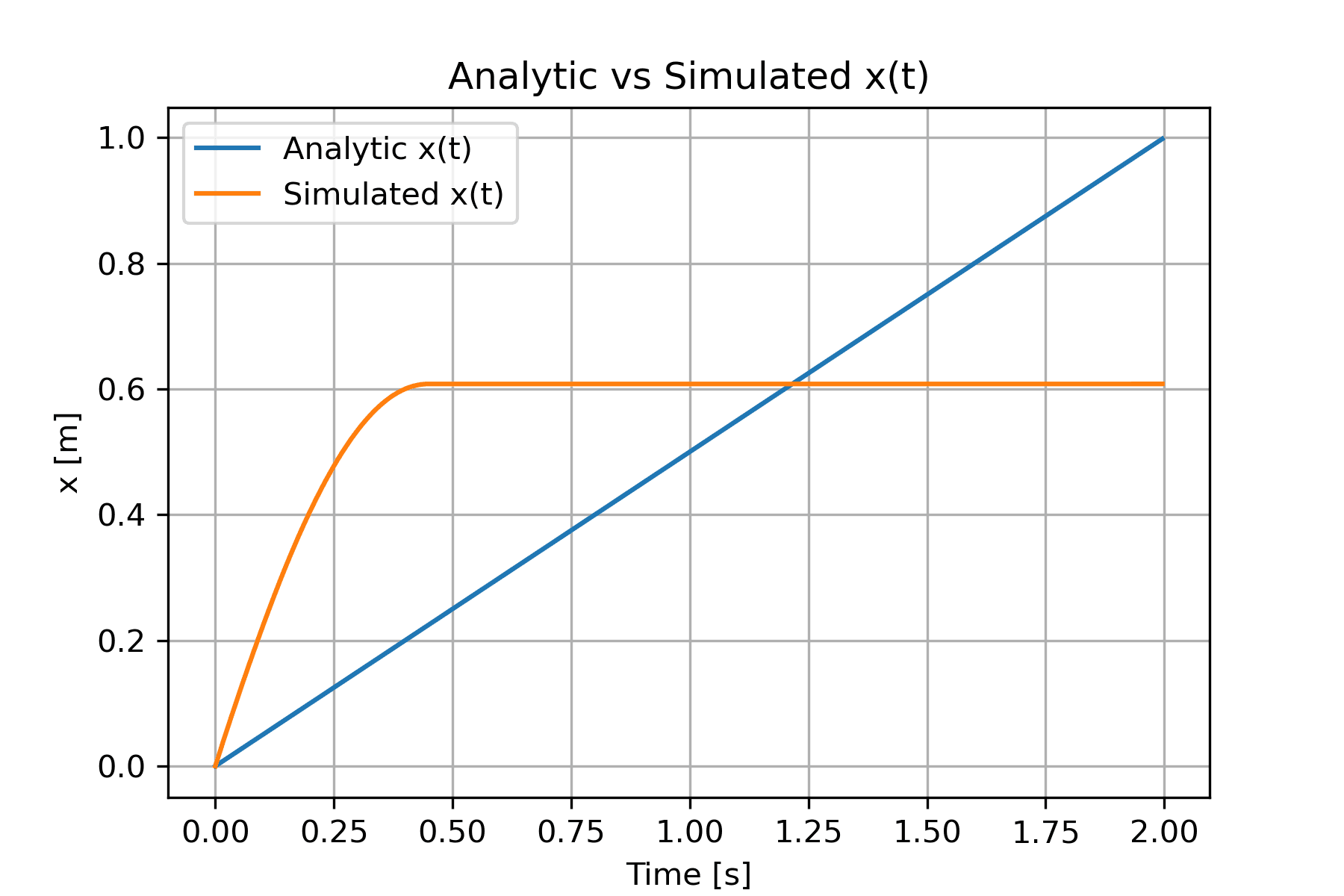
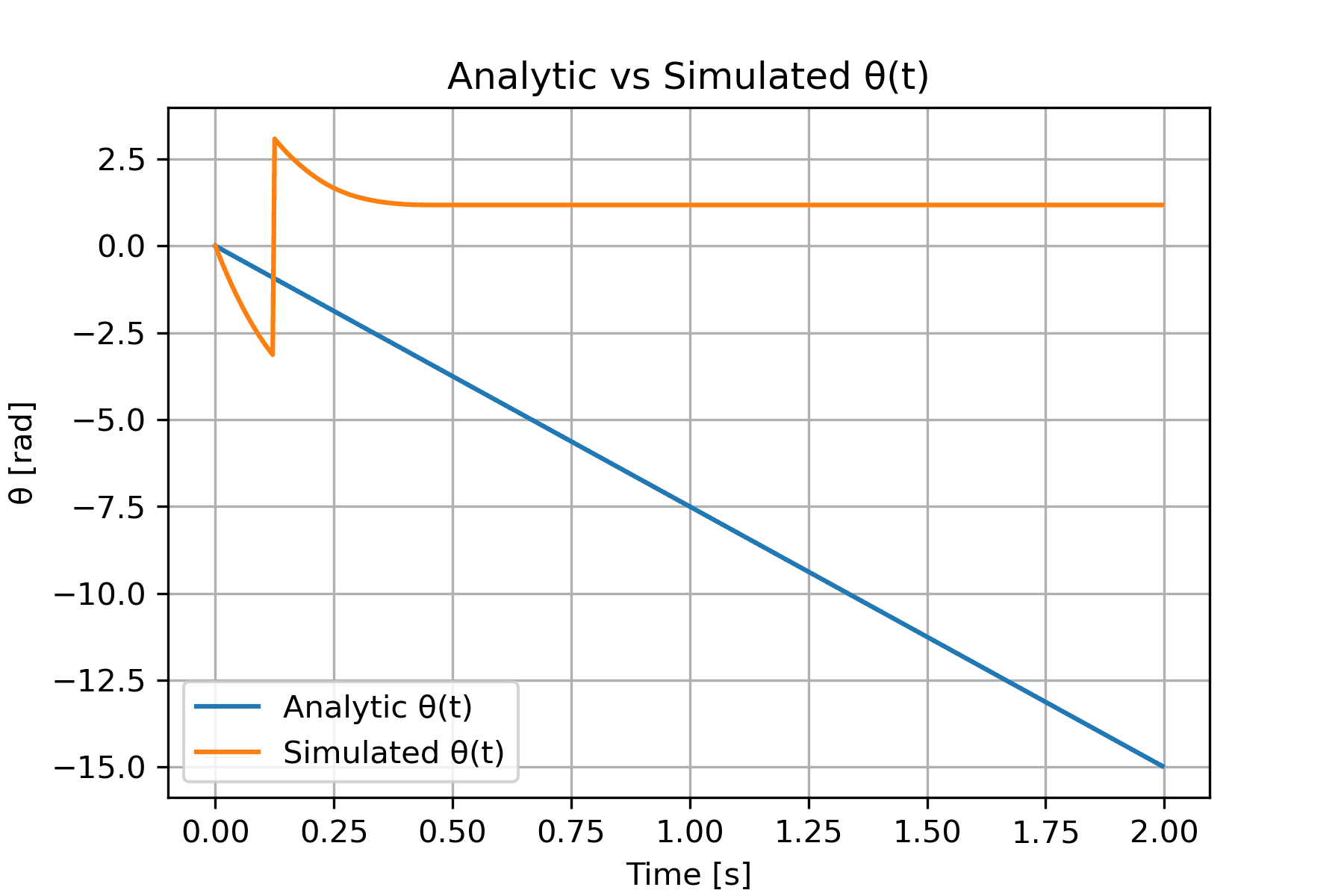
The models diverge immediately and significantly. In simulation, rotation decays within 0.1–0.2 seconds due to Coulomb friction at the box corners. Translation slows and saturates as the object transitions from sliding to sticking. The analytic model predicts indefinite drift — simulation stops the object after a finite distance.
Why They Diverge
Three mechanisms drive the gap: strong rotational damping from corner slip against the ground, finite-duration contact that alters the effective impulse magnitude and direction, and continuous ground friction that the analytic model assumes away entirely.
Inverse Problem Results
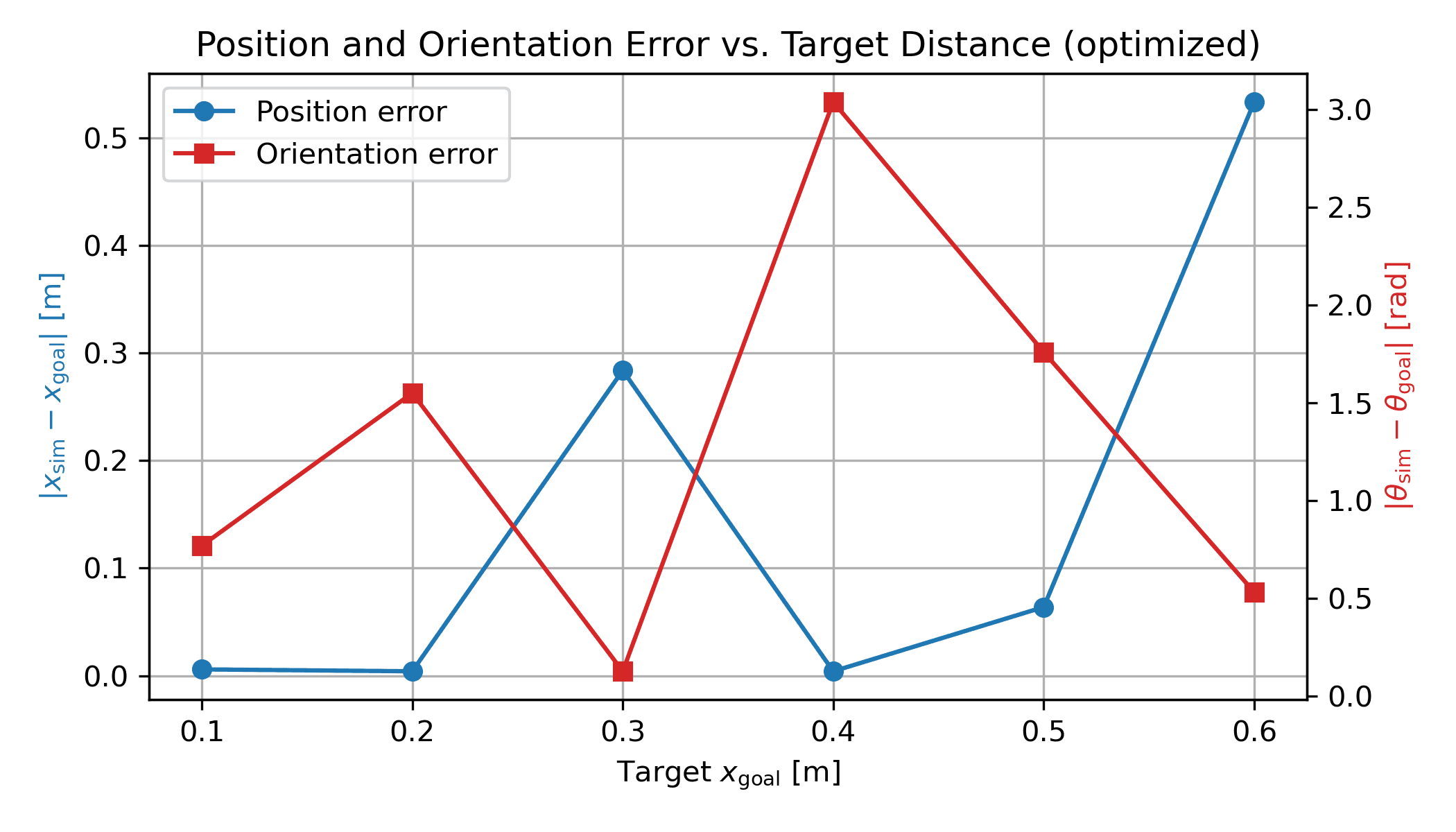
Only targets aligned with the simulation's natural damped drift direction were reachable with low error. Targets requiring sustained rotation — analytically valid — were physically unreachable because rotation decayed too fast to influence the trajectory. Position and orientation accuracy traded off directly: minimizing one typically required accepting large error in the other.
Discussion
The central finding: contact physics collapses the space of reachable post-impact motions far below what idealized models predict. Many poses that are analytically reachable are dynamically unreachable in the presence of friction. This isn't a modeling error — it's a fundamental property of real contact that any manipulation planner relying on impulse-momentum theory needs to account for explicitly.
This connects directly to a broader theme in my work: the gap between how systems behave in models and how they behave in reality. Closing that gap requires either physics-aware planning that builds friction and dissipation in from the start, or sensing that measures the actual post-impact state and corrects in real time.
My Contributions
Derived the closed-form analytic impulse-momentum model for off-center planar impact.
Implemented the physics simulation and designed the analytic-vs-simulated comparison framework.
Ran experiments sweeping contact locations, impulse magnitudes, and target distances.
Solved the inverse problem: optimizing fingertip speed for target pose reachability.
Identified and characterized the three contact-physics mechanisms driving analytic-simulation divergence.