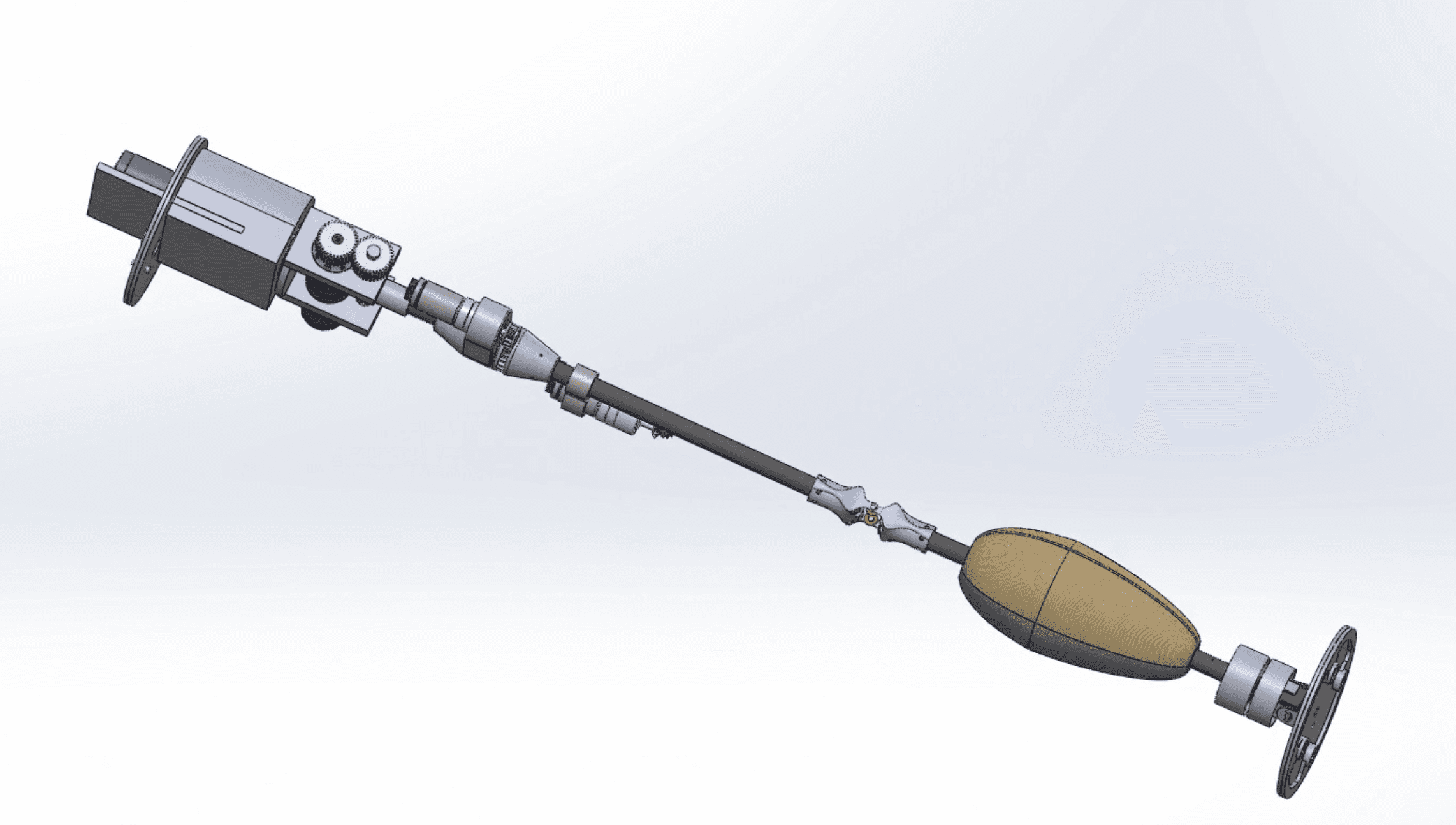
Designing a life-sized humanoid arm for safe human interaction requires solving three problems simultaneously: achieving human-scale range of motion across multiple joints, routing wiring and actuation through rotating axes without binding, and enclosing the mechanism in a compliant skin that survives repeated contact.
This project delivered a 6-DoF robotic arm with a 3-DoF shoulder, single-axis elbow, and 3-DoF wrist using a combination of direct-drive and tendon-pulley actuation, enclosed in an inflatable skin. I led mechanical design across all three joints.
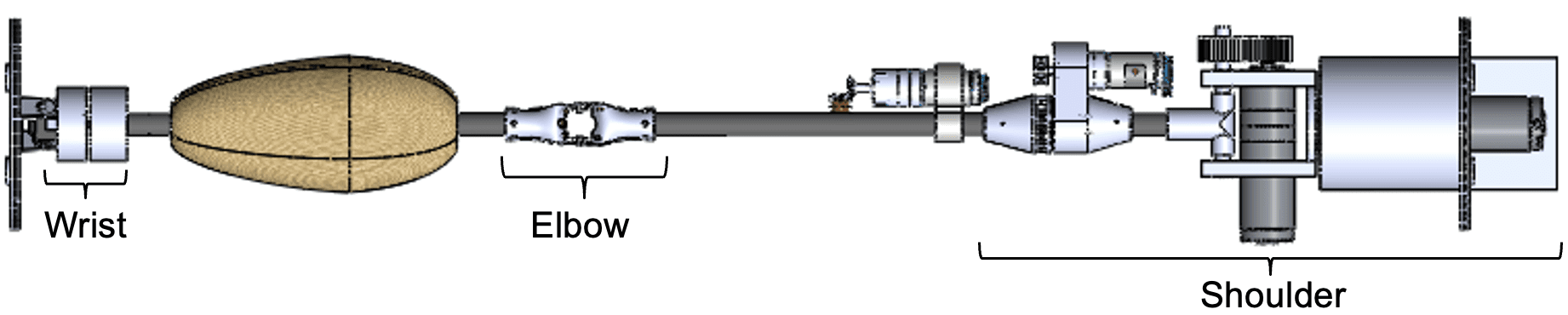
1. Shoulder Joint (3-DoF)
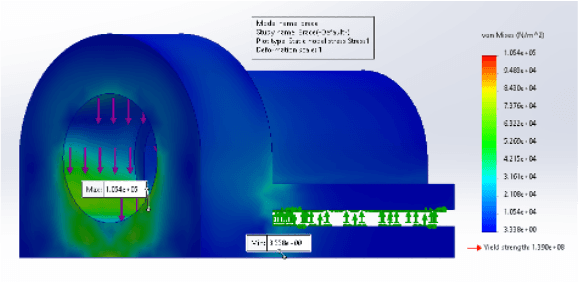
Triple-axis rotational joint enabling front raises, lateral motion, and axial roll. Joint placement and range scaled proportionally from human biomechanics data. FEA-validated shoulder brace confirmed stress of 105 kPa under 100 N load with adequate factor of safety.
2. Elbow Joint (Single-Axis Flexion)
Motor-driven pulley system with a pin-joint architecture. Frame designed with internal channels routing wiring and pneumatic tubes through the rotational axis — eliminating external cable management and maintaining clean integration with wrist and skin systems.
3. Wrist Joint (3-DoF)
Three-servo direct-drive mechanism enabling θ and φ rotation. Custom connectors align axes precisely with embedded wire channels routed underneath the soft skin interface.
4. Inflatable Skin
Balloon skin attaches at wrist and shoulder via disk-and-ring sealing structures with cutouts for electrical routing. Schrader valve allows controlled inflation. Seal geometry was designed specifically to prevent pinching during joint motion — a non-trivial constraint given the range of motion at both attachment points.
6-DoF Integrated Assembly
Shoulder, elbow, and wrist achieve full-range motion across all axes. Joint stack-up validated against human biomechanical norms with consistent axis alignment across the full arm.
FEA-Validated Structure
Shoulder brace: 105 kPa stress under 100 N load, factor of safety confirmed.
Elbow assembly: cantilever analysis identified stress concentrations at shoulder and elbow frames, directly guiding reinforcement placement.
The central mechanical challenge was managing complexity across three joints simultaneously — wire routing, pneumatic lines, and structural load paths all competing for space through rotating axes. Careful axis alignment planning was essential; misalignment at any joint propagated through the entire arm assembly.
The inflatable skin added a soft-robotics integration problem on top of the mechanism design problem. Clamp and seal geometry had to accommodate full joint range without pinching or leaking — a constraint that influenced joint geometry upstream.
Led mechanical design for shoulder, elbow, and wrist joints — CAD modeling, DoF planning, and dimensional scaling.
Performed FEA on shoulder brace and elbow assembly, using results to guide reinforcement decisions.
Designed wire and pneumatic routing through all rotational axes.
Coordinated mechanical, soft-robotics, and control subteam integration.