Human-Interactive Robotic Arm with Tendon-Pulley Actuation
@ Queen’s University — Undergraduate Capstone Project
Keywords
Introduction
Designing a life-sized humanoid arm for safe human interaction requires solving three problems simultaneously: achieving human-scale range of motion across multiple joints, routing wiring and actuation through rotating axes without binding, and enclosing the mechanism in a compliant skin that survives repeated contact.
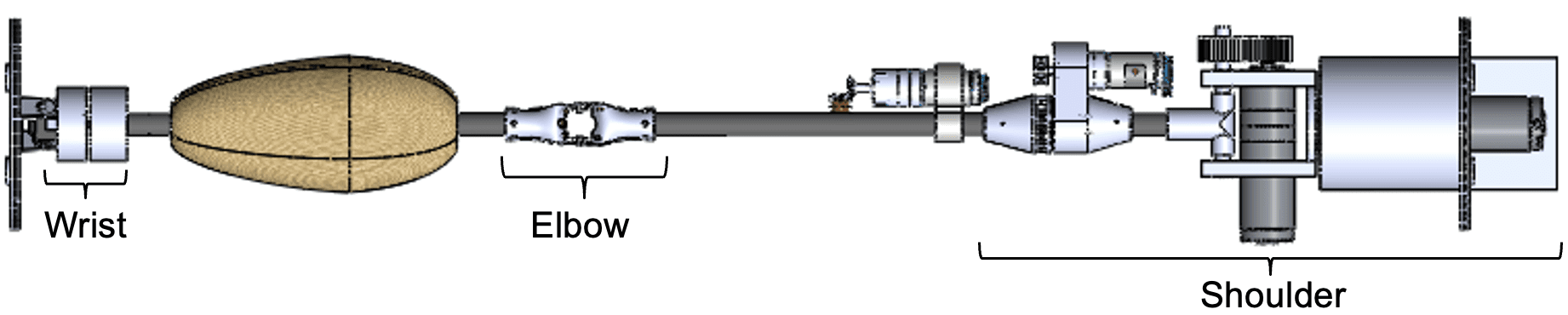
This project delivered a 6-DoF robotic arm with a 3-DoF shoulder, single-axis elbow, and 3-DoF wrist using a combination of direct-drive and tendon-pulley actuation, enclosed in an inflatable skin. I led mechanical design across all three joints.
Methods
1. Shoulder Joint (3-DoF)
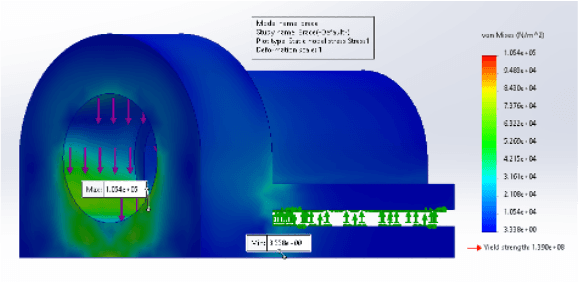
Triple-axis rotational joint enabling front raises, lateral motion, and axial roll. Joint placement and range scaled proportionally from human biomechanics data. FEA-validated shoulder brace confirmed stress of 105 kPa under 100 N load with adequate factor of safety.
2. Elbow Joint (Single-Axis Flexion)
Motor-driven pulley system with a pin-joint architecture. Frame designed with internal channels routing wiring and pneumatic tubes through the rotational axis — eliminating external cable management and maintaining clean integration with wrist and skin systems.
3. Wrist Joint (3-DoF)
Three-servo direct-drive mechanism enabling θ and φ rotation. Custom connectors align axes precisely with embedded wire channels routed underneath the soft skin interface.
4. Inflatable Skin
Balloon skin attaches at wrist and shoulder via disk-and-ring sealing structures with cutouts for electrical routing. Schrader valve allows controlled inflation. Seal geometry was designed specifically to prevent pinching during joint motion — a non-trivial constraint given the range of motion at both attachment points.
Results
6-DoF Integrated Assembly
Shoulder, elbow, and wrist achieve full-range motion across all axes. Joint stack-up validated against human biomechanical norms with consistent axis alignment across the full arm.
FEA-Validated Structure
Shoulder brace: 105 kPa stress under 100 N load, factor of safety confirmed.
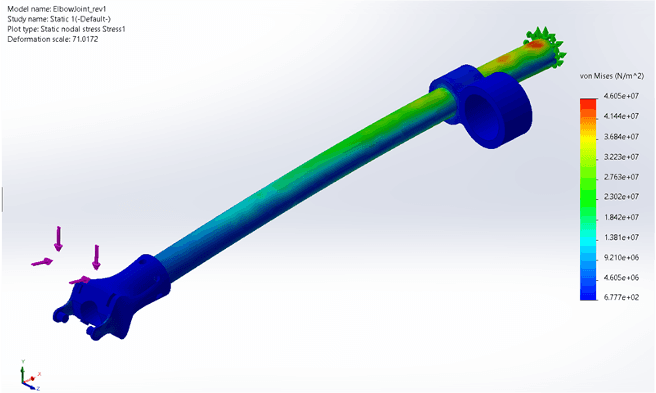
Elbow assembly: cantilever analysis identified stress concentrations at shoulder and elbow frames, directly guiding reinforcement placement.
Discussion
Designing a life-sized humanoid arm for safe human interaction requires solving three problems simultaneously: achieving human-scale range of motion across multiple joints, routing wiring and actuation through rotating axes without binding, and enclosing the mechanism in a compliant skin that survives repeated contact.
This project delivered a 6-DoF robotic arm with a 3-DoF shoulder, single-axis elbow, and 3-DoF wrist using a combination of direct-drive and tendon-pulley actuation, enclosed in an inflatable skin. I led mechanical design across all three joints.
My Contributions
Designing a life-sized humanoid arm for safe human interaction requires solving three problems simultaneously: achieving human-scale range of motion across multiple joints, routing wiring and actuation through rotating axes without binding, and enclosing the mechanism in a compliant skin that survives repeated contact.
This project delivered a 6-DoF robotic arm with a 3-DoF shoulder, single-axis elbow, and 3-DoF wrist using a combination of direct-drive and tendon-pulley actuation, enclosed in an inflatable skin. I led mechanical design across all three joints.